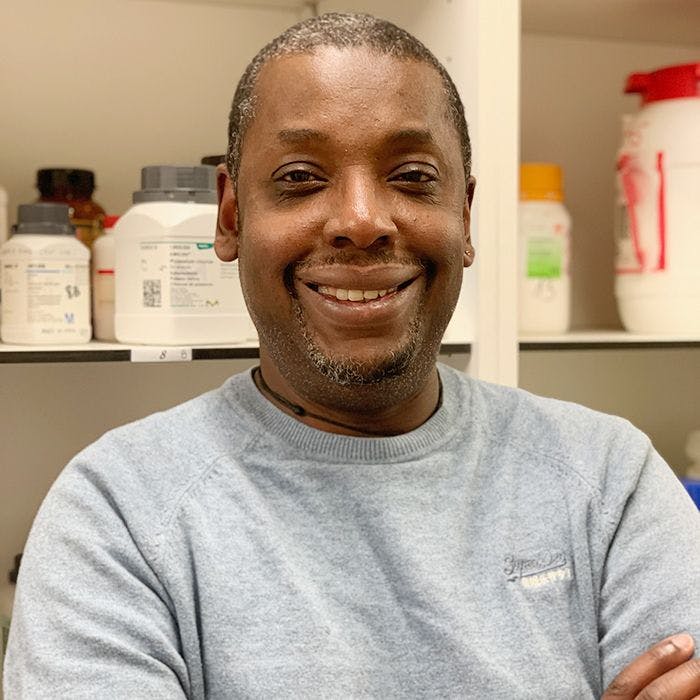
Freddy Abrassart
Technical Support

Institut de Duve Avenue Hippocrate 75 - B1.75.03 1200 Bruxelles
The Assi Lab explores how diverse extracellular matrix (ECM) environments drive signaling programs that shape cancer cell behavior and adaptability.
How do cells sense specific ECM cues and convert them into signaling and transcriptional programs that define their biological responses?

The Extracellular matrix (ECM) orchestrates various biological processes, including cell adhesion, differentiation, proliferation and migration. Because of its central physiological importance, the ECM undergoes extensive remodeling that contributes to the etiology of various diseases, including cancer.
The ECM consists of two major compartments: the basement membrane (e.g. laminin, collagen-IV) and the interstitial matrix (e.g. collagen-I, fibronectin). Despite its diverse composition, the ECM has been traditionally studied as a single, homogeneous scaffold, leaving multiple facets of ECM biology unexplored.
To address this gap, Mohamad Assi and his team investigate how tumor cells respond to individual ECM components (for example collagen-I versus laminin). Through systematically comparing cells exposed to distinct ECM microenvironments, they identify both shared and component-specific signaling programs. Their work reveals how ECM diversity contributes to tumor heterogeneity and uncovers potential therapeutic vulnerabilities.
Another priority of the Assi Lab is to determine whether the principles governing tumor–ECM interactions can inform research on rare genetic disorders caused by defective ECM sensing. To pursue these questions, the laboratory’s experimental approach combines positive selection CRISPR screens, 3D organotypic cultures, protein biochemistry and mouse models.
Mohamad Assi trained in biochemistry and molecular biology at the Lebanese University (Lebanon) and the University of La Réunion (La Réunion Island). In 2016, he obtained a doctoral degree in cancer biology at the University of Rennes (France), in the laboratory of Prof. Amélie Rébillard. Then, he joined the laboratory of Prof. Patrick Jacquemin at the de Duve institute, as a FNRS postdoctoral fellow. During this stay, he developed tools including transgenic mouse models and antibodies to uncover the inflammatory and redox mechanisms driving pancreas tumorigenesis. From 2021 to 2025, Dr. Assi trained as a postdoctoral fellow in the Lab of Prof. Alec C Kimmelman at the University of New York Langone Health, where he developed an expertise in genetic CRISPR screening. Using this technology, he discovered that the ECM contributes to pancreatic cancer heterogeneity by coordinating diverse biological processes, including tumor cell proliferation and autophagic survival. In 2026, Dr. Assi returned to the de Duve institute through the Brains-for-Brussels program funded by Innoviris. The same year, he obtained a permanent position at the FNRS and became a group leader at the de Duve institute and an associate professor at UCLouvain.
Assi M, Wang R, Kawaler EA, Sohn ASW, Zahidunnabi Dewan M, Kalfakakou D, Encarnacion-Rosado J, Kapner KS, Ganguly K, Paulo JA, Simeone DM, Aguirre AJ, Banh RS, Kimmelman AC
Cell (2026) 189(6):1731-1747.e25
Assi M, Kimmelman AC
Nat Cancer (2023) 4(5):596-607
Assi M, Achouri Y, Loriot A, Dauguet N, Dahou H, Baldan J, Libert M, Fain JS, Guerra C, Bouwens L, Barbacid M, Lemaigre FP, Jacquemin P
Cancer Res (2021) 81(10):2679-2689
Buckens H, Pirenne S, Achouri Y, Baldan J, Dahou H, Bouwens L, Lemaigre FP, Jacquemin P, Assi M
Cell Mol Gastroenterol Hepatol (2021) 12(2):741-743
